It’s a serious question: What if the next environmental problem is something we have not yet learned to look for?
One of the central challenges in dealing with contaminated land is that investigations are usually shaped by what we already understand.
We test for the contaminants we know to expect, based on site history, regulatory requirements and available science. But we only ever seem to be a few years from another emerging contaminant.
Lessons from past contaminants
History shows that our understanding of environmental risk changes over time. Materials once valued for their performance can later become long-term environmental and public health concerns.
- Asbestos was widely used for its insulation and fire-resistant properties. In the UK, its use was not fully banned until 1999. Asbestos-containing materials can still be found in buildings constructed or refurbished before then.
- Today, the consequences of historic exposure are still being felt. HSE estimates that around 5,000 people die each year from asbestos-related diseases in Great Britain, often decades after exposure.
- PCBs, the contaminants central to Michael Sheen’s BBC documentary, were once widely used for their industrial properties. They are now recognised as persistent organic pollutants, with UK Government guidance identifying PCBs among substances subject to controls because of their persistence and environmental impact.
These are not simply stories from the past. They are reminders that an apparently useful material can become an environmental legacy when its long-term risks are not fully understood.
What about the chemicals we are dealing with today?
This is where PFAS enters the conversation.
PFAS are a large family of synthetic chemicals that have been widely used since the 1940s. Their exceptional resistance to degradation is why they are often called “forever chemicals”. They are now being detected in rivers, groundwater and other parts of the environment, including land where fires were extinguished using AFFF foam.
The UK Government published its first PFAS Plan in February this year, describing PFAS as one of the country’s most pressing chemical challenges.
The lesson is clear: our understanding of contamination does not stand still.
That means contaminated land investigations may need to ask a broader question. It is not only, “What contamination is here?” but also, “What might we not be looking for?”
The next environmental legacy
This does not mean every site contains an unknown contaminant, or that we should test for every chemical imaginable.
It means we need to combine a strong understanding of site history and risk profile with current science, appropriate analytical techniques and a willingness to adapt when new evidence emerges.
A site investigated 20 years ago may have been assessed using the best knowledge and methods available at the time. Today, we may approach the same site differently because we may:
- ask different questions;
- understand contaminant pathways better;
- have more sensitive analytical techniques; and
- recognise risks that were not previously considered significant.
The absence of evidence is not always evidence of absence. Sometimes, we were simply not looking for the right thing.
Remediation needs to evolve too
This is why innovation matters. The contamination challenges of tomorrow may not look exactly like those of yesterday.
At ATG Group, we are increasingly working on complex remediation challenges, including PFAS, alongside more established contamination issues.
Our focus is not simply on removing material from a site. It is on understanding what happens to contamination if it must leave the site.
Where technically and environmentally appropriate, there may be opportunities to:
- treat contamination;
- stabilise it;
- contain it; or
- remediate it rather than simply moving it somewhere else.
Because if we simply transfer a problem from one location to another, have we really solved it?
Learning from the past
Each generation of contaminants has something to teach us:
- Asbestos shows how long the consequences of past decisions can last.
- PCBs show how persistent industrial chemicals can become environmental legacies.
- PFAS shows that the challenge has not gone away. We are still learning about the chemicals around us and how best to deal with them.
There may be other contaminants that become tomorrow’s environmental concern. We do not know what they are yet, but we can be better prepared to identify them, understand them and develop solutions for them.
Don’t Bury the Problem
We cannot predict every environmental challenge of the future. But we can choose not to create unnecessary ones.
That is at the heart of Don’t Bury the Problem.
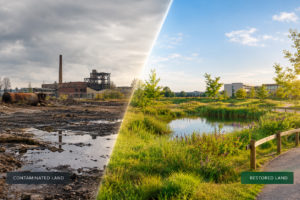
Remediate it. Restore the land. Protect the future.