
We have spent decades dealing with the environmental consequences of chemicals that were once considered useful, innovative and safe. But are industry leaders and governments doing enough to make sure we don’t repeat the same mistakes?
The second part of BBC documentary Buried with Michael Sheen aired last night. The two-part series has brought renewed attention to the legacy of polychlorinated biphenyls – better known as PCBs – and allegations surrounding the historic disposal of PCB-containing waste in Wales and north-west England.
PCBs were once regarded as remarkable chemicals. They were stable, resistant to heat and difficult to break down – properties that made them useful across a wide range of industrial applications.
Those same properties ultimately became part of the problem.
PCBs are persistent in the environment and have been recognised as highly hazardous chemicals. They are now banned globally and classified as persistent organic pollutants.
And that brings us to a question that extends far beyond what happened decades ago.
What about the chemicals we are using today?
One of the clearest examples is PFAS – per- and polyfluoroalkyl substances.
Often referred to as ‘forever chemicals’, PFAS are a large family of manufactured chemicals that have been used since the 1940s. Their resistance to heat, water, oil and chemical degradation made them incredibly useful in products ranging from firefighting foams and industrial processes to consumer goods.
But the characteristic that made them so useful also makes them exceptionally difficult to deal with once they enter the environment.
The Environment Agency describes PFAS as “forever chemicals” because of their stability and resistance to degradation, with their persistence creating the potential for long-term exposure of people and wildlife. PFAS have been detected widely in English surface waters and groundwater.
In February this year, the UK Government published its first PFAS Plan, recognising PFAS as one of the country’s most pressing chemical challenges and setting out measures to understand sources, tackle environmental pathways and reduce exposure. The plan specifically includes developing guidance for dealing with legacy PFAS pollution on contaminated land.
That tells us something important.
PFAS is no longer a future environmental issue. It is a problem we are dealing with now.
Are we creating tomorrow’s legacy?
This is where the story of PCBs and the emerging challenge of PFAS intersect. Looking back at historic contamination, it is easy to ask: “How did we allow this to happen?”
But perhaps we should also be asking: “What are we doing today that future generations might ask the same question about?”
The people who used PCBs decades ago did not necessarily have the environmental knowledge, analytical techniques or remediation technologies available to us today.
We do.
And that gives us an opportunity to do things differently. We know that some chemicals are extremely persistent. We also know that contamination can move through soil and groundwater.
And we are also acutely aware that substances can remain in the environment long after their original use has stopped.
Increasingly, we have the technology to investigate, contain and remediate contamination rather than simply moving it somewhere else.
So, perhaps the responsibility is not just to manage the contamination we have inherited, but to prevent today’s problems becoming tomorrow’s legacy.
“Forever” doesn’t have to mean “impossible”
The term forever chemicals can make PFAS contamination sound like an environmental problem for which there is no answer.
That isn’t how we see it.
At ATG Group, we have been developing our expertise in PFAS remediation since 2018 and are now working on PFAS investigation and remediation projects across the UK. We have also secured contracts involving the remediation of PFAS-contaminated land and groundwater.
The challenge is complex.
There isn’t one universal solution for every PFAS site.
The right approach depends on the chemicals involved, their concentrations, the geology, groundwater conditions, the pathways by which contamination could move and the intended future use of the site.
That’s why remediation needs to begin with understanding the problem.
At ATG Group, we work with consultants, laboratories, technology providers and regulators to develop bespoke remediation strategies. Our approach can include technologies designed to treat or stabilise contaminated soils, manage groundwater and reduce the potential for contaminants to leach into the wider environment.
In some circumstances, that means our LockedIn® technology can be used to stabilise contaminants within soil and reduce their leachability, rather than simply excavating material and sending it elsewhere. Other PFAS remediation approaches include groundwater treatment, permeable reactive barriers and specialist treatment systems.
The important point is that “forever” does not have to mean “untreatable”.
Technology is developing rapidly.
And so is our understanding of how best to deal with these contaminants.
We shouldn’t wait another generation
There is an uncomfortable lesson in the story of PCBs. Sometimes environmental problems don’t become obvious immediately.
A chemical can be useful for decades before its persistence or wider environmental consequences are fully understood.
By the time the evidence is overwhelming, the contamination may already be widespread. That’s why the emergence of PFAS should make us think differently.
We shouldn’t wait until another generation is looking back at us and asking why we didn’t act when we had the opportunity.
The UK’s new PFAS Plan is an important recognition of the scale of the challenge. But regulation and monitoring are only part of the answer. We also need research, innovation and practical remediation solutions that can deal with contamination already present in our soil and water.
Today’s decisions become tomorrow’s legacy
The story of contaminated land is often presented as something that belongs in the past. It doesn’t. Every site we investigate today has a history.
And every remediation decision we make today has a future.
We can excavate and dispose of material where that is the appropriate solution. But where technically and environmentally appropriate, we should also ask whether we can treat it, stabilise it, recover it or remediate it in place.
That’s not just about reducing costs or avoiding landfill.
It’s about thinking beyond the immediate project.
It’s about asking: “What happens to this contamination after we’ve finished with the site?”
And perhaps most importantly: “Will the solution we’re choosing today still look like the right decision 20, 30 or 50 years from now?”
We have a choice
PCBs are a reminder of the environmental legacies that can be left behind by previous generations. PFAS is a reminder that the story is still being written.
We can’t change what has already happened.
But we can choose how we respond to the contamination we discover today.
We can invest in better science, develop better technologies and investigate sites properly.
And we can look beyond simply moving contaminated material from one place to another.
At ATG Group, that’s what motivates our work in environmental remediation.
We don’t want to bury today’s problems for tomorrow’s generation to discover.
We want to find innovative ways to deal with them today.
Because “forever” should describe the lesson we learn – not the problem we leave behind.
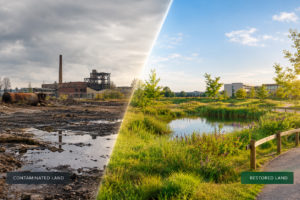
Remediate it. Restore the land. Protect the future.