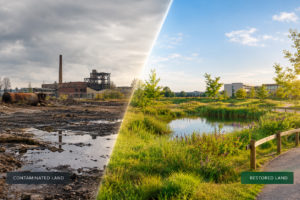

We can’t change what previous generations left behind – but we can change what happens next.
Across the UK, land affected by historic industrial activity, waste disposal and previous uses presents a continuing challenge. Some sites contain contamination that has been there for decades. Others are only now being investigated as land is brought forward for redevelopment.
But contaminated land doesn’t have to remain a problem forever.
The right approach can turn a difficult site into an opportunity for regeneration.
Remediation should mean more than removal
When we talk about contaminated land, it is easy to think about excavation first.
Dig it out. Load it onto lorries. Take it somewhere else. Sometimes that is the right solution. But it isn’t automatically the best one.
The Environment Agency’s Land Contamination Risk Management (LCRM) guidance takes a risk-based approach to contaminated land. It recommends assessing feasible remediation options, evaluating them in detail, and selecting the option that is appropriate for the specific site and risks involved.
That is an important distinction. The question shouldn’t simply be: “How quickly can we remove the contaminated material?”
It should be: “What solution delivers the best long-term outcome for the site, the environment and the people who will use it?”
There is no one-size-fits-all solution
Every contaminated site is different. The contaminants may be different, and the geology may be different. Groundwater conditions, surrounding land uses, receptors, and the future use of the site can all influence what remediation approach is appropriate.
That is why remediation should start with understanding the risk and the objectives for the site. The LCRM process is deliberately staged, moving from risk assessment through options appraisal and, where appropriate, remediation, verification and long-term monitoring.
There may be situations where excavation and disposal are the most appropriate options.
But there may also be opportunities to treat, stabilise, contain, recover or otherwise manage contamination on or close to the site.
The important thing is to assess the options rather than assuming the answer before the investigation has even begun.
Think about the whole environmental outcome
There is another question that deserves more attention: What is the environmental cost of remediation?
Moving thousands of tonnes of contaminated material can involve excavation, transport, treatment or disposal, along with the associated use of energy and resources.
That doesn’t automatically make excavation wrong. But it does mean that the wider consequences should form part of the decision.
The Environment Agency, alongside the other UK environmental regulators, supports a sustainable approach to land contamination risk management. Its LCRM guidance recommends considering environmental, social and economic impacts from the early stages of a project.
This is consistent with the principles of sustainable remediation, which aim to balance environmental, social and economic outcomes rather than considering technical performance or cost in isolation.
For a remediation project, that means thinking beyond the immediate question of where the contaminated soil goes.
It means considering the whole journey – from investigation and treatment through to the site’s eventual use.
Don’t just move the problem
One of the biggest questions we should ask when dealing with contaminated land is deceptively simple: What happens to the contamination after it leaves the site?
Moving contaminated material from one location to another can be a legitimate and necessary part of remediation.
But where technically and environmentally appropriate, there can be significant value in considering treatment or remediation approaches that reduce the contamination itself rather than simply transferring it elsewhere.
This is particularly relevant as we encounter increasingly complex contaminants and develop a better understanding of historic and emerging environmental risks.
CIRIA’s work on contaminated land recognises the importance of selecting appropriate remedial treatments and managing risks according to the circumstances of individual sites. Its work also covers the challenges associated with brownfield regeneration and the sustainable management of soil.
From brownfield to opportunity
Contaminated land is often described as a liability.
But it can also be an opportunity.
Brownfield sites are frequently located in areas where there is already infrastructure, transport connectivity and demand for new homes, businesses or community facilities.
CIRIA has worked extensively with practitioners involved in brownfield regeneration and contaminated land, developing guidance around the assessment and management of risks associated with bringing these sites back into productive use.
The Government’s own contaminated land guidance makes the wider benefits clear: dealing with land contamination can help make the environment clean and safe and, through regeneration, can enhance health and wellbeing as well as the economic, ecological and amenity value of an area.
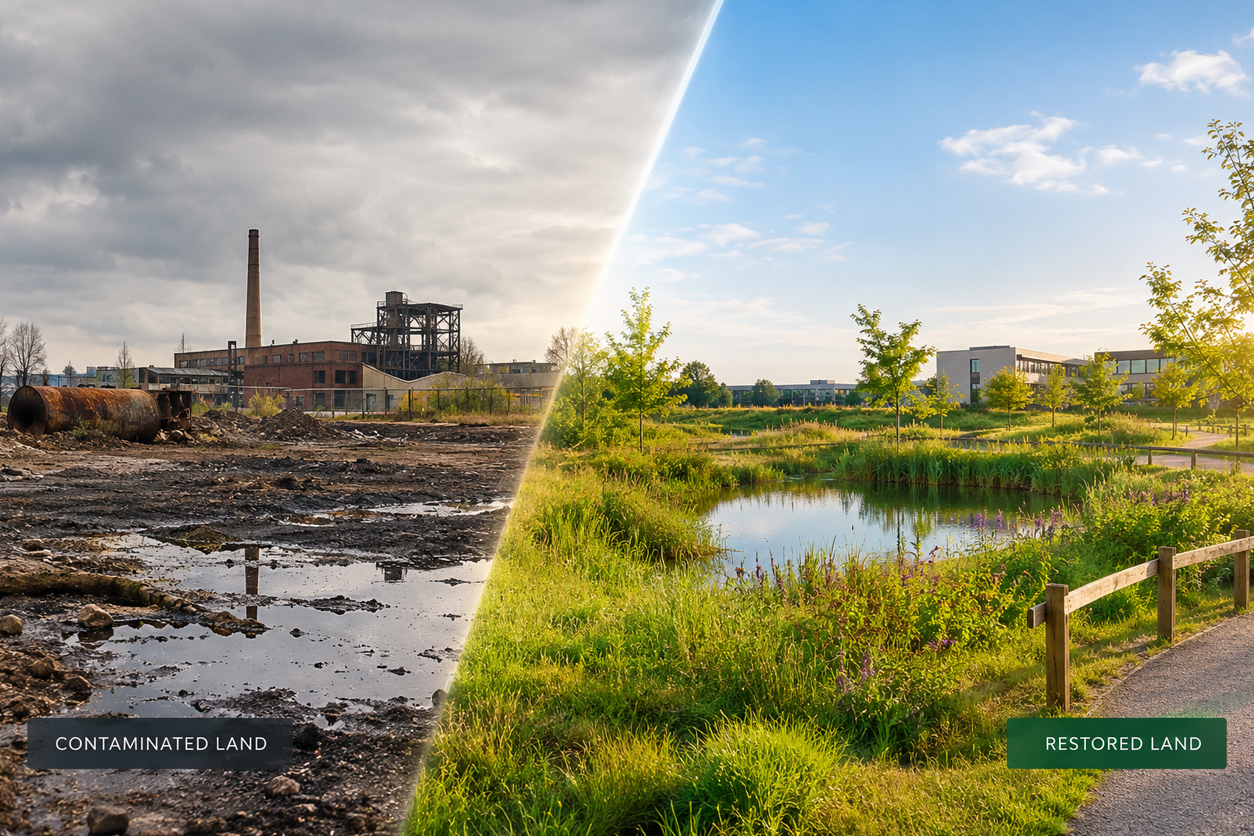
That is the opportunity. Not simply to make contaminated land acceptable. But to restore land so that it can have a useful future.
Technology has a role to play
At ATG Group, we believe remediation needs to be driven by the circumstances of the site rather than by a single prescribed solution. Our work includes land remediation, contaminated soil treatment, stabilisation and solutions for emerging contaminants such as PFAS.
Our LockedIn® technology is one example of how alternative remediation approaches can be considered where they are technically appropriate.
We also continue to develop our approach to PFAS, recognising that some of the contaminants we are dealing with today may present environmental challenges for decades to come.
The objective isn’t simply to move material. It is to achieve a better outcome for the site.
Look beyond the site boundary
Perhaps the biggest change we need to make is how we define success.
Success shouldn’t simply be measured by how many tonnes of contaminated soil have been excavated.
It should be measured by what happens afterwards:
- Has the risk been managed?
- Is the contamination being treated or contained appropriately?
- Has the remediation been verified?
- What is the environmental impact of the remediation itself?
- Ultimately, can the land now support a beneficial future use?
These principles are reflected in the Environment Agency’s LCRM framework, which includes remediation, verification, and, where necessary, long-term monitoring and maintenance.
We can’t change the past. But we can change the outcome.
There will always be contaminated land.
Some of it is the legacy of industrial activity that happened decades ago. Some contamination is only now being recognised. And some of the environmental challenges we will face in the future may involve substances we don’t yet fully understand.
We can’t go back and change what happened.
But we can make better decisions about what happens next.
We can investigate properly and consider the full range of remediation options. We can think about sustainability, and we can treat contamination where appropriate rather than simply moving it elsewhere.
We can think beyond the immediate project to the people and environment that will inherit the land.
Because ultimately, successful remediation isn’t just about what we remove, it’s about what we leave behind.
From contaminated land to restored land.
Don’t Bury the Problem.
Remediate it. Restore the land. Protect the future.